Load Data
Code # load data for analysis load ("../data/wrangled_data/dt_ana_full.RData" )Analysis Strategy
We evaluate whether the predictive structure for violent intent differs across samples (countries; with a focal interest in the Jihadist sample) using two complementary strategies:
a multilevel model that separates within- from between-country effects and, in a second step, allows country-specific slopes;
a two-step meta-analysis that fits the same model within each country, then pools coefficient estimates and tests heterogeneity.
Why both?
The multilevel model performs one-step partial pooling (stabilizing noisy country estimates via shrinkage), while the meta-analysis gives two-step, fully transparent country-by-country estimates with classic heterogeneity statistics (Q, τ², I²). Agreement between the two strengthens credibility.
Prepare Data
We use group-mean centering (suffix _cw) for individual-level predictors to estimate within-country relationships, and include country means (grand-mean centered) to estimate between-country differences. This avoids conflating contextual differences with individual-level effects.
Code <- dt_ana_full %>% mutate (obsessive_passion_country_mean_c = obsessive_passion_country_mean - mean (obsessive_passion_country_mean, na.rm = TRUE ),moral_neutralization_country_mean_c = moral_neutralization_country_mean - mean (moral_neutralization_country_mean, na.rm = TRUE ),perceived_discrimination_country_mean_c= perceived_discrimination_country_mean- mean (perceived_discrimination_country_mean,na.rm = TRUE )
Multilevel Models
Random Intercept Model
This model allows country-specific baselines for violent intent while estimating common within-country slopes for the centered predictors and between-country effects for country means.
Code <- lmer (~ + + + + + + 1 | country),data = ana_df, REML = TRUE summ (mod_ml_ri)
Observations
10395
Dependent variable
violent_intent
Type
Mixed effects linear regression
AIC
33932.29
BIC
33997.53
Pseudo-R² (fixed effects)
0.48
Pseudo-R² (total)
0.50
Est.
S.E.
t val.
d.f.
p
(Intercept)
2.13
0.04
55.44
38.15
0.00
obsessive_passion_cw
0.30
0.01
31.83
10350.23
0.00
moral_neutralization_cw
0.48
0.01
36.75
10350.23
0.00
perceived_discrimination_cw
0.28
0.01
22.76
10350.26
0.00
obsessive_passion_country_mean_c
0.25
0.06
4.13
38.16
0.00
moral_neutralization_country_mean_c
0.76
0.14
5.34
41.08
0.00
perceived_discrimination_country_mean_c
-0.15
0.12
-1.28
43.27
0.21
Group
Parameter
Std. Dev.
country
(Intercept)
0.24
Residual
1.23
Group
# groups
ICC
country
42
0.04
Code # apa_lmer_summary(mod_ml_ri) Random Slopes Model
We now allow country-specific slopes for the individual-level predictors. This addresses the question: do predictors of violent intent vary across samples? If so, we should see non-zero variance in the random slopes and improved model fit.
Code <- lmer (~ + + + + + + 1 + + + | country),data = ana_df, REML = TRUE ,control = lmerControl (optimizer = "bobyqa" ,optCtrl = list (maxfun = 1e6 ))summ (mod_ml_rs)
Observations
10395
Dependent variable
violent_intent
Type
Mixed effects linear regression
AIC
33626.69
BIC
33757.17
Pseudo-R² (fixed effects)
0.47
Pseudo-R² (total)
0.51
Est.
S.E.
t val.
d.f.
p
(Intercept)
2.13
0.04
54.86
35.91
0.00
obsessive_passion_cw
0.31
0.02
14.42
41.33
0.00
moral_neutralization_cw
0.45
0.03
15.84
43.13
0.00
perceived_discrimination_cw
0.28
0.03
8.95
39.59
0.00
obsessive_passion_country_mean_c
0.32
0.05
6.08
39.15
0.00
moral_neutralization_country_mean_c
0.68
0.12
5.53
42.88
0.00
perceived_discrimination_country_mean_c
-0.17
0.10
-1.63
46.70
0.11
Group
Parameter
Std. Dev.
country
(Intercept)
0.24
country
obsessive_passion_cw
0.12
country
moral_neutralization_cw
0.16
country
perceived_discrimination_cw
0.18
Residual
1.20
Group
# groups
ICC
country
42
0.04
Code <- update (mod_ml_ri, REML = FALSE )<- update (mod_ml_rs, REML = FALSE )<- anova (mod_ml_ri_ml, mod_ml_rs_ml) # LRT for added random slopes <- as.data.frame (model_comp)%>% kable (., caption = "Comparing fixed and random slope model" ) %>% kable_styling (full_width = F, latex_options = c ("hold_position" , "scale-down" ))
Comparing fixed and random slope model
mod_ml_ri_ml
9
33896.46
33961.70
-16939.23
33878.46
NA
NA
NA
mod_ml_rs_ml
18
33594.34
33724.83
-16779.17
33558.34
320.1144
9
0
Model fit improves drasticially with random slopes (not suprisingly given the many different countries). We now assess how the Jihadist sample differs from the other samples.
Code <- broom.mixed:: tidy (mod_ml_rs, effects = "ran_vals" ) %>% filter (grepl ("_cw$" , term)) %>% arrange (level, term) %>% kable (., caption = "Random slopes of the multilevel model" ) %>% kable_styling (full_width = F, latex_options = c ("hold_position" , "scale-down" )) %>% scroll_box (width = "100%" , height = "600px" )
Random slopes of the multilevel model
ran_vals
country
Algeria
moral_neutralization_cw
0.1920010
0.0803617
ran_vals
country
Algeria
obsessive_passion_cw
-0.0460439
0.0467942
ran_vals
country
Algeria
perceived_discrimination_cw
-0.0854935
0.0764843
ran_vals
country
Argentina
moral_neutralization_cw
0.1195694
0.0816873
ran_vals
country
Argentina
obsessive_passion_cw
-0.0084796
0.0588949
ran_vals
country
Argentina
perceived_discrimination_cw
-0.2774958
0.0561102
ran_vals
country
Australia
moral_neutralization_cw
-0.1265603
0.0722609
ran_vals
country
Australia
obsessive_passion_cw
-0.0364591
0.0592341
ran_vals
country
Australia
perceived_discrimination_cw
0.3136681
0.0883920
ran_vals
country
Austria
moral_neutralization_cw
-0.1398595
0.0706105
ran_vals
country
Austria
obsessive_passion_cw
-0.0587912
0.0527009
ran_vals
country
Austria
perceived_discrimination_cw
0.1518382
0.0828104
ran_vals
country
Brazil
moral_neutralization_cw
-0.1774514
0.0745897
ran_vals
country
Brazil
obsessive_passion_cw
0.2213237
0.0617989
ran_vals
country
Brazil
perceived_discrimination_cw
-0.1082629
0.0521255
ran_vals
country
Canada
moral_neutralization_cw
-0.2381855
0.0791714
ran_vals
country
Canada
obsessive_passion_cw
0.0339901
0.0716020
ran_vals
country
Canada
perceived_discrimination_cw
0.1450911
0.0902130
ran_vals
country
Colombia
moral_neutralization_cw
0.0245262
0.0801067
ran_vals
country
Colombia
obsessive_passion_cw
-0.0876488
0.0564467
ran_vals
country
Colombia
perceived_discrimination_cw
-0.0304747
0.0733970
ran_vals
country
Czech
moral_neutralization_cw
-0.3922567
0.0609153
ran_vals
country
Czech
obsessive_passion_cw
0.0906297
0.0525231
ran_vals
country
Czech
perceived_discrimination_cw
0.1737718
0.0660281
ran_vals
country
Denmark
moral_neutralization_cw
-0.1558344
0.0751766
ran_vals
country
Denmark
obsessive_passion_cw
0.1917418
0.0605169
ran_vals
country
Denmark
perceived_discrimination_cw
0.1809179
0.0819405
ran_vals
country
Egypt
moral_neutralization_cw
0.1596812
0.0843010
ran_vals
country
Egypt
obsessive_passion_cw
-0.1532270
0.0426987
ran_vals
country
Egypt
perceived_discrimination_cw
-0.2244731
0.0901010
ran_vals
country
Finland
moral_neutralization_cw
-0.1387134
0.0787455
ran_vals
country
Finland
obsessive_passion_cw
0.0754402
0.0637466
ran_vals
country
Finland
perceived_discrimination_cw
0.2154536
0.0943051
ran_vals
country
France
moral_neutralization_cw
-0.0610810
0.0847441
ran_vals
country
France
obsessive_passion_cw
0.0872091
0.0548869
ran_vals
country
France
perceived_discrimination_cw
0.0669262
0.1024786
ran_vals
country
Germany
moral_neutralization_cw
-0.0475450
0.0637135
ran_vals
country
Germany
obsessive_passion_cw
0.0180907
0.0568698
ran_vals
country
Germany
perceived_discrimination_cw
0.1504188
0.0707971
ran_vals
country
Greece
moral_neutralization_cw
0.0312585
0.0851622
ran_vals
country
Greece
obsessive_passion_cw
0.0160002
0.0639230
ran_vals
country
Greece
perceived_discrimination_cw
-0.1179148
0.0701434
ran_vals
country
Hungary
moral_neutralization_cw
-0.1113527
0.0664661
ran_vals
country
Hungary
obsessive_passion_cw
0.1633337
0.0517267
ran_vals
country
Hungary
perceived_discrimination_cw
-0.0847497
0.0646274
ran_vals
country
India
moral_neutralization_cw
-0.2505040
0.0609407
ran_vals
country
India
obsessive_passion_cw
-0.0136345
0.0513325
ran_vals
country
India
perceived_discrimination_cw
0.3003111
0.0737940
ran_vals
country
Israel
moral_neutralization_cw
-0.0325392
0.0738343
ran_vals
country
Israel
obsessive_passion_cw
0.1417073
0.0592403
ran_vals
country
Israel
perceived_discrimination_cw
-0.0128433
0.0702347
ran_vals
country
Italy
moral_neutralization_cw
-0.0090027
0.0765229
ran_vals
country
Italy
obsessive_passion_cw
0.0141864
0.0532230
ran_vals
country
Italy
perceived_discrimination_cw
-0.0211381
0.0717603
ran_vals
country
Jihadist
moral_neutralization_cw
0.0865049
0.1044518
ran_vals
country
Jihadist
obsessive_passion_cw
0.1244679
0.0778443
ran_vals
country
Jihadist
perceived_discrimination_cw
-0.2618898
0.0656130
ran_vals
country
Jordan
moral_neutralization_cw
0.0013468
0.0792926
ran_vals
country
Jordan
obsessive_passion_cw
-0.0089181
0.0455062
ran_vals
country
Jordan
perceived_discrimination_cw
-0.0771970
0.0791745
ran_vals
country
Kuwait
moral_neutralization_cw
0.1776016
0.0692008
ran_vals
country
Kuwait
obsessive_passion_cw
0.0108887
0.0492743
ran_vals
country
Kuwait
perceived_discrimination_cw
-0.0899695
0.0678726
ran_vals
country
Lebanon
moral_neutralization_cw
0.0701736
0.0925618
ran_vals
country
Lebanon
obsessive_passion_cw
0.0022176
0.0484758
ran_vals
country
Lebanon
perceived_discrimination_cw
-0.1644307
0.0879113
ran_vals
country
Malaysia
moral_neutralization_cw
0.1414571
0.0689734
ran_vals
country
Malaysia
obsessive_passion_cw
-0.0055680
0.0511423
ran_vals
country
Malaysia
perceived_discrimination_cw
-0.2912478
0.0843283
ran_vals
country
Mexico
moral_neutralization_cw
0.0701559
0.0837297
ran_vals
country
Mexico
obsessive_passion_cw
-0.0340595
0.0567684
ran_vals
country
Mexico
perceived_discrimination_cw
-0.0627637
0.0720584
ran_vals
country
Morocco
moral_neutralization_cw
0.2354822
0.0841350
ran_vals
country
Morocco
obsessive_passion_cw
-0.1518985
0.0459924
ran_vals
country
Morocco
perceived_discrimination_cw
-0.1159362
0.0875263
ran_vals
country
Netherlands
moral_neutralization_cw
0.0979797
0.0728834
ran_vals
country
Netherlands
obsessive_passion_cw
-0.2541074
0.0421493
ran_vals
country
Netherlands
perceived_discrimination_cw
0.3225652
0.0804401
ran_vals
country
Nigeria
moral_neutralization_cw
0.0975448
0.0698545
ran_vals
country
Nigeria
obsessive_passion_cw
-0.2381799
0.0490565
ran_vals
country
Nigeria
perceived_discrimination_cw
-0.0272519
0.0690244
ran_vals
country
Norway
moral_neutralization_cw
-0.1485635
0.0750772
ran_vals
country
Norway
obsessive_passion_cw
0.0199445
0.0633163
ran_vals
country
Norway
perceived_discrimination_cw
0.2352716
0.0900451
ran_vals
country
Pakistan
moral_neutralization_cw
0.0561238
0.0694043
ran_vals
country
Pakistan
obsessive_passion_cw
-0.0515232
0.0522035
ran_vals
country
Pakistan
perceived_discrimination_cw
0.0425067
0.0689245
ran_vals
country
Philippines
moral_neutralization_cw
-0.0202829
0.0716696
ran_vals
country
Philippines
obsessive_passion_cw
-0.1370612
0.0492047
ran_vals
country
Philippines
perceived_discrimination_cw
0.1025999
0.0668927
ran_vals
country
Poland
moral_neutralization_cw
-0.0038385
0.0702188
ran_vals
country
Poland
obsessive_passion_cw
0.1282037
0.0542743
ran_vals
country
Poland
perceived_discrimination_cw
-0.1193458
0.0619080
ran_vals
country
Portugal
moral_neutralization_cw
-0.0691270
0.0909377
ran_vals
country
Portugal
obsessive_passion_cw
-0.0160151
0.0641157
ran_vals
country
Portugal
perceived_discrimination_cw
-0.0475283
0.0897867
ran_vals
country
Romania
moral_neutralization_cw
0.0060282
0.0716728
ran_vals
country
Romania
obsessive_passion_cw
0.0680740
0.0547266
ran_vals
country
Romania
perceived_discrimination_cw
-0.0203428
0.0629523
ran_vals
country
Saudi Arabia
moral_neutralization_cw
0.1160802
0.0678950
ran_vals
country
Saudi Arabia
obsessive_passion_cw
-0.0388539
0.0439716
ran_vals
country
Saudi Arabia
perceived_discrimination_cw
-0.0196265
0.0680703
ran_vals
country
Spain
moral_neutralization_cw
-0.1171271
0.0725383
ran_vals
country
Spain
obsessive_passion_cw
0.1354121
0.0567547
ran_vals
country
Spain
perceived_discrimination_cw
-0.0387644
0.0708830
ran_vals
country
Sweden
moral_neutralization_cw
-0.0782831
0.0765485
ran_vals
country
Sweden
obsessive_passion_cw
0.0594792
0.0532810
ran_vals
country
Sweden
perceived_discrimination_cw
-0.0138309
0.0777131
ran_vals
country
Thailand
moral_neutralization_cw
-0.0842085
0.0609635
ran_vals
country
Thailand
obsessive_passion_cw
-0.1193783
0.0451944
ran_vals
country
Thailand
perceived_discrimination_cw
0.3394758
0.0633234
ran_vals
country
Tunisia
moral_neutralization_cw
0.0469952
0.0784233
ran_vals
country
Tunisia
obsessive_passion_cw
0.1141371
0.0437071
ran_vals
country
Tunisia
perceived_discrimination_cw
0.0018545
0.0783353
ran_vals
country
Turkey
moral_neutralization_cw
0.0901197
0.0698930
ran_vals
country
Turkey
obsessive_passion_cw
-0.1127295
0.0402284
ran_vals
country
Turkey
perceived_discrimination_cw
-0.1368012
0.0557231
ran_vals
country
US Democrats
moral_neutralization_cw
0.2834864
0.0644258
ran_vals
country
US Democrats
obsessive_passion_cw
-0.1298294
0.0503789
ran_vals
country
US Democrats
perceived_discrimination_cw
-0.0984404
0.0708602
ran_vals
country
US Republicans
moral_neutralization_cw
0.1845948
0.0743497
ran_vals
country
US Republicans
obsessive_passion_cw
-0.0405001
0.0492952
ran_vals
country
US Republicans
perceived_discrimination_cw
-0.0665710
0.0705959
ran_vals
country
United Kingdom
moral_neutralization_cw
0.1136054
0.0841577
ran_vals
country
United Kingdom
obsessive_passion_cw
0.0264287
0.0660298
ran_vals
country
United Kingdom
perceived_discrimination_cw
-0.1278869
0.0926761
Code <- ana_df %>% group_by (country) %>% do (model = lm (~ + + data = .<- ana_df %>% group_by (country) %>% nest () %>% mutate (model = map (data, ~ lm (~ + + data = .xtidy = map (model, broom:: tidy)%>% select (country, tidy) %>% unnest (tidy) %>% filter (term != "(Intercept)" ) %>% select (country, term, estimate, std.error)
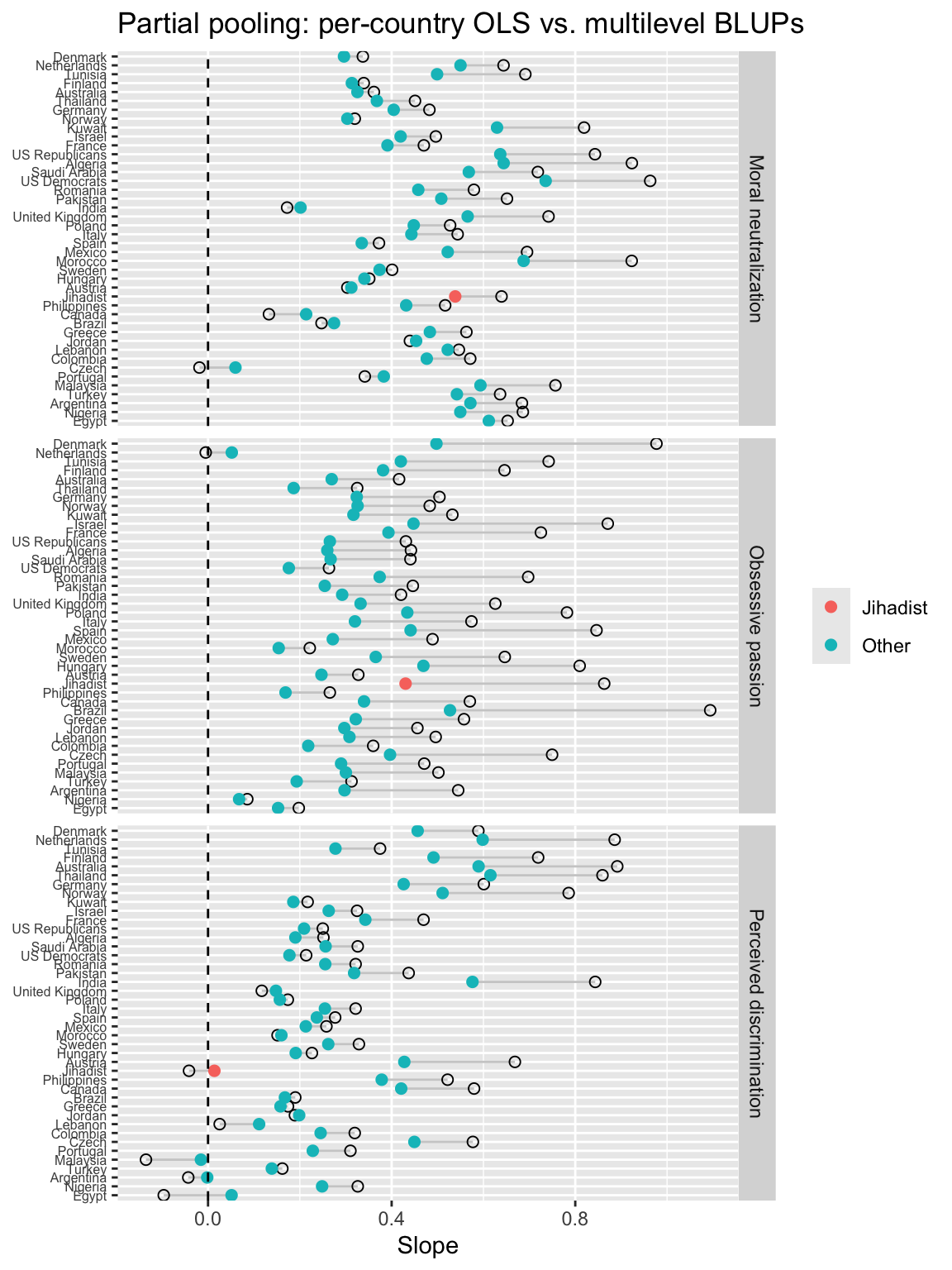
The following shrinkage (partial-pooling) contrasts, for each country and each predictor, the stand-alone country OLS (orinary least squares) slope with the multilevel Best Linear Unbiased Prediction (BLUP) slope which comes from the random-slopes model.
Hollow circle (OLS): the slope estimated by fitting a separate linear model within that country (no pooling).
Filled circle (BLUP): the country’s slope implied by the multilevel model = fixed effect + random deviation (i.e., after partial pooling).
Segment connecting them: the amount and direction of shrinkage from OLS → BLUP.
Long segments = noisier country estimates (often small n) get pulled more toward the overall mean slope.
Short segments = precise country estimates change little.
OLS
For each country, we fit a simple regression model just on that country’s data. The slope we get is the country-specific OLS slope.
Properties:
Uses only that country’s sample.
Very unbiased, but high variance if the country has a small sample size (noisy, unstable).
BLUB
The multilevel model’s estimate of a country’s slope = the global fixed slope plus that country’s random deviation.
Properties:
Shrinks noisy country slopes toward the overall mean slope (partial pooling).
Countries with large N or strong signal stay close to their OLS.
Countries with small N or noisy estimates get pulled toward the overall slope.
Code # 3) Shrinkage plot: per-country OLS slopes vs. multilevel BLUPs (highlight Jihadist) # Map *_gmz terms to *_cw to align labels <- country_effects %>% :: mutate (term = dplyr:: recode (term,"obsessive_passion_gmz" = "obsessive_passion_cw" ,"moral_neutralization_gmz" = "moral_neutralization_cw" ,"perceived_discrimination_gmz" = "perceived_discrimination_cw" # BLUP = fixed slope + random deviation <- broom.mixed:: tidy (mod_ml_rs, effects = "fixed" ) %>% :: filter (grepl ("_cw$" , term)) %>% :: select (term, fix = estimate)<- broom.mixed:: tidy (mod_ml_rs, effects = "ran_vals" ) %>% :: filter (grepl ("_cw$" , term)) %>% :: select (country = level, term, ran = estimate)<- re_df %>% dplyr:: left_join (fixef_df, by = "term" ) %>% dplyr:: mutate (blup = fix + ran)<- ols %>% :: rename (ols = estimate) %>% :: select (country, term, ols) %>% :: inner_join (blup %>% dplyr:: select (country, term, blup), by = c ("country" ,"term" )) %>% :: mutate (group = dplyr:: if_else (country == "Jihadist" , "Jihadist" , "Other" ),term_lab = dplyr:: recode (term,obsessive_passion_cw = "Obsessive passion" ,moral_neutralization_cw = "Moral neutralization" ,perceived_discrimination_cw = "Perceived discrimination" ggplot (plot_df, aes (y = reorder (country, blup))) + geom_segment (aes (x = ols, xend = blup, yend = country), alpha = .5 , color = "grey60" ) + geom_point (aes (x = ols), shape = 1 , size = 2 ) + geom_point (aes (x = blup, color = group), size = 2 ) + geom_vline (xintercept = 0 , linetype = 2 ) + facet_wrap (~ term_lab, scales = "free_y" , ncol = 1 , strip.position = "right" ) + labs (x = "Slope" , y = NULL , color = NULL ,title = "Partial pooling: per-country OLS vs. multilevel BLUPs" + theme (axis.text.y = element_text (size = 6 ) # smaller country labels # optional polish: # panel.spacing.y = unit(0.6, "lines") # tighten vertical space between facets